 Opinion
Alabama Wants Fewer Voters. The SAVE Act Is How.
Written by Brent Wilson on
March 4, 2026 | Opinion
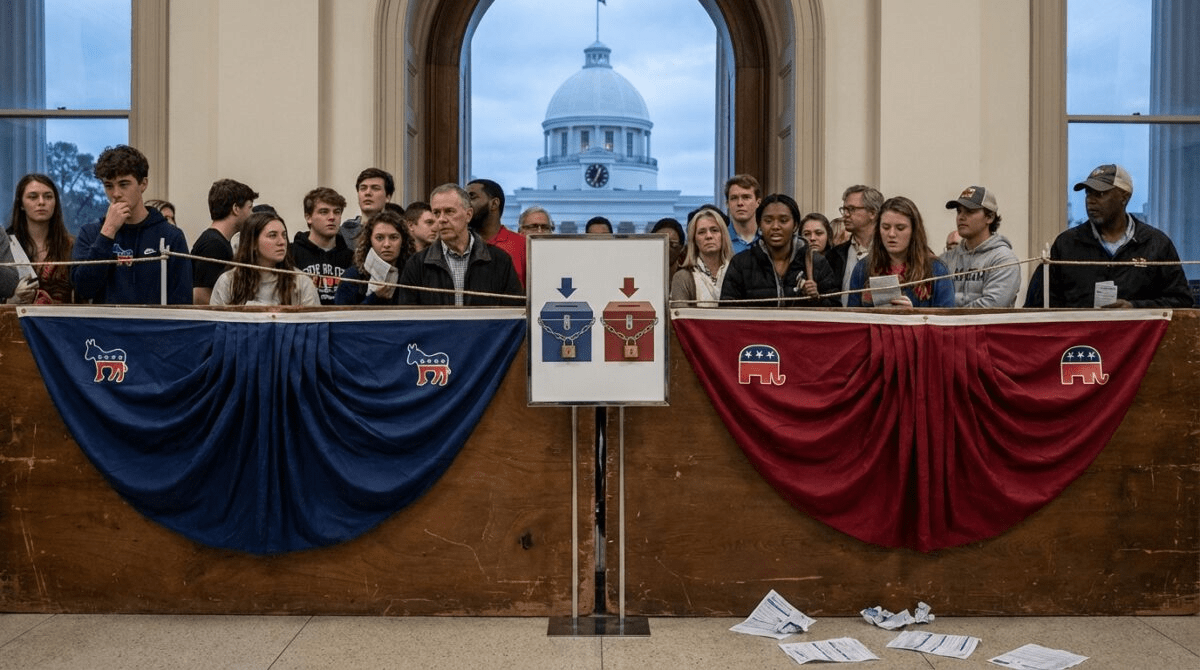
Let me tell you what HB541 does, because its supporters, nor the sponsor Ernie Yarbrough, sure don’t want to.
The so-called Safeguard Alabama Voter Engagement Act would require every Alabama voter to register with a political party before casting a ballot in a primary election. Starting January 1, 2027, if you haven’t pledged allegiance to the Democrats or Republicans, you don’t get to vote in the elections that actually matter.
That’s it. That’s the bill. Dress it up however you want, but at its core, HB541 tells hundreds of thousands of Alabamians that their participation in democracy is conditional.
Oh, and if you’re already registered with a party and have a change of heart? There’s a 60-day blackout period before a primary through the general election where you’re locked in. Welcome to freedom.
Supporters will tell you this is about “protecting party integrity.” Which is a polite way of saying they don’t trust the voters.
Your Money, Their Election
Here’s the part that should make every taxpayer’s blood boil.
Primary elections are funded with public money. Your money. The Secretary of State’s office runs them. County clerks administer them. Taxpayer-funded poll workers show up at 6 a.m. to open the doors. Taxpayer-funded machines count the ballots.
But under HB541, only registered party members get to use any of it.
Former Indiana state representative Choice Edwards nailed this in a 2020 Orlando Sentinel column when he argued that denying voters the chance to participate in publicly funded elections amounts to taxation without representation. He was writing about Florida at the time, but the principle doesn’t change when you cross the state line.
Political parties are private organizations. If they want total control over who picks their nominees, they’re welcome to rent a banquet hall, buy some folding chairs, and hold a convention on their own dime. What they shouldn’t get to do is use the government’s election infrastructure — paid for by all of us — while slamming the door on voters who decline to join their club.
The “Better Candidates” Myth
Proponents love to argue that closed primaries produce better, more ideologically consistent candidates. Research says otherwise.
Political scientist Seth Masket and colleagues Eric McGhee, Boris Shor, Nolan McCarty, and Steve Rogers conducted a large-scale study examining state legislators across all 50 states. Published in the American Journal of Political Science in 2014, their findings were unambiguous: the type of primary system — open or closed — had no measurable effect on how extreme or moderate the resulting legislators turned out to be.
Let that sink in. Two decades of data. All 50 states. And closed primaries didn’t produce meaningfully different candidates than open ones.
What closed primaries do produce is a smaller, more partisan electorate. And when you shrink the pool of voters to only the most committed partisans, you get candidates who play to that crowd. NPR’s Ron Elving made this point in 2022, noting that primaries have increasingly become dominated by ideological true believers with almost no reason to reach voters who might fall somewhere between the two parties.
Alabama doesn’t need candidates who are better at being partisan. Alabama needs candidates who are better at governing. There is a difference, in case the legislature has forgotten.
The Primary Is the Election
In most Alabama races, whoever wins the Republican primary wins the seat. Period. The general election is a formality.
So when HB541 locks independent voters out of the primary, it doesn’t just exclude them from one step of the process. It excludes them from the only step that matters.
Nick Troiano, executive director of Unite America and author of “The Primary Solution,” has documented this extensively. His research found that roughly 8 percent of eligible voters cast ballots in primaries that effectively decided the outcome in 83 percent of U.S. House elections. Troiano published his argument for abolishing party primaries in The Atlantic in 2021, and the numbers haven’t gotten any better since.
Eight percent of voters picking 83 percent of winners. And HB541 wants to make that pool even smaller.
When Pennsylvania was debating similar legislation, their House Majority Leader Dave Reed — a Republican — pushed to open primaries, not close them. He pointed out that with hundreds of thousands of independent voters locked out of primary elections, the state was excluding a massive chunk of its electorate from the contests that actually determined representation.
Reed was a Republican making this argument. Let that register with HB541’s supporters.
The Sabotage Boogeyman
Ah, but what about sabotage? Surely hordes of Democrats are sneaking into Republican primaries to vote for the weakest candidate. It’s chaos out there. Dogs and cats living together.
Except it’s not happening. Not in any meaningful way.
FairVote, a nonpartisan organization that researches voting reforms, has examined this claim repeatedly and found that deliberate sabotage in open primaries is exceedingly rare. They’ve also pointed out the obvious: if someone really wants to game the system, they can register with a party and do it in a closed primary just as easily.
Alabama GOP Chairman John Wahl tipped the real motivation when he said on the Jeff Poor Show in 2025 that he was concerned about Democrats voting in Republican primaries — specifically in the context of Tommy Tuberville’s gubernatorial run. That’s not election integrity. That’s a party boss worried he can’t control the outcome if too many people are allowed to vote.
And there it is.
What This Is Really About
HB541 isn’t about protecting elections. It’s about controlling them.
It creates new administrative burdens — tracking party affiliations, maintaining voter history records, enforcing blackout periods — all to solve a problem that doesn’t exist. It requires the Secretary of State to retain party ballot information and current affiliation data. More government tracking of citizens’ political beliefs. How very small-government of them.
Supporters will say it’s easy to register with a party. Just do it at the polling place on election day. But asking voters to make a binding partisan declaration on the spot, with no time to research candidates or understand the implications, isn’t voter empowerment. It’s a loyalty test at the door.
Alabama’s open primary system works. It encourages candidates to appeal beyond their base. It lets every taxpayer participate in elections they fund. It doesn’t require the government to catalog citizens’ political affiliations.
HB541 is a solution to a problem that exists only in the imaginations of party leaders who’d rather have fewer voters than more accountable candidates.
The legislature should kill this bill and you should tell them to, if you care about choice. Alabama voters deserve better than being told they need a membership card to participate in their own democracy.

Bama Politics is committed to giving Alabama residents a voice.
This is an opinion column and does not necessarily represent or reflect the opinions of Bama Politics, its editors or its reporters.
The opinions are those of its author. Want to have your voice heard?
Send us a message through our opinion contact page.